The Local-First Revolution: Reclaiming Ownership and Speed in Modern App Development
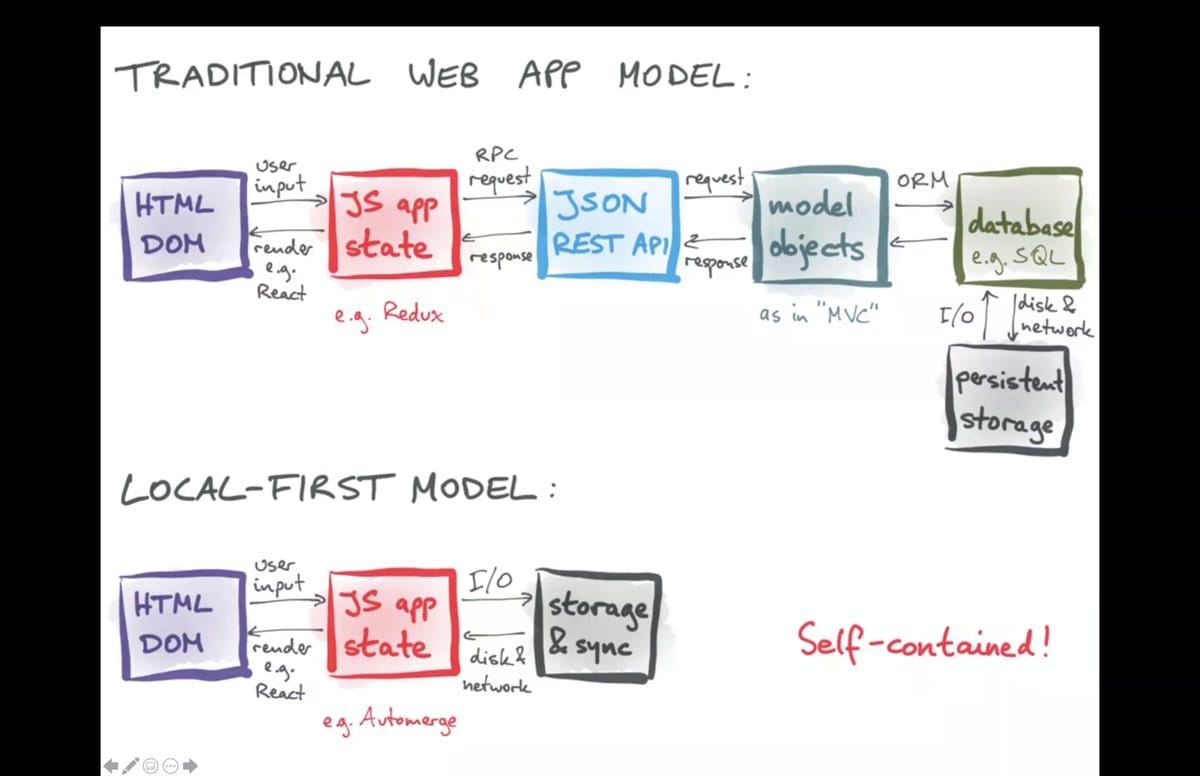
For the past decade, the software industry has been dominated by the "Cloud-First" paradigm. We migrated our productivity, creativity, and data into centralized data centers, relying on constant internet connectivity to perform even the simplest tasks. While this move facilitated seamless synchronization and global collaboration, it introduced two major structural pain points: latency (the frustrating "spinning wheel") and data fragility (the risk of losing access if a server goes down or a company disappears).
Enter Local-First Software. This is not merely an "offline mode" patch; it is a fundamental architectural movement. It combines the best of both worlds—the robustness, privacy, and blazing speed of traditional 1990s-style desktop applications with the powerful multi-device synchronization and collaboration features of the modern cloud.
1. What is Local-First? (The 7 Pillars of Autonomy) 📜
Coined by the research lab Ink & Switch, local-first software is built on the radical principle that the primary, authoritative copy of the data lives on the user's device, not on a remote server. To be truly local-first, an application must satisfy seven rigorous criteria that redefine the relationship between the user and their digital tools:
- Fast (Instantaneous Interaction): In a cloud-first world, every click often waits for a round trip to a server (sometimes across an ocean). Local-first apps interact directly with local memory/disk, providing 0ms latency. The UI never freezes while waiting for the network.
- Multi-device: Even though data is local, it isn't "trapped." Your progress on a smartphone must sync effortlessly to your tablet and laptop once a connection is available.
- Offline-capable: Whether you are in a subway tunnel, on an airplane, or in a rural area with intermittent 3G, the app functions perfectly. You don't "lose a character" because the "Save" button failed.
- Collaboration: It must support multi-user workflows. Imagine a team editing a design or a document; local-first allows each person to work independently and merges their changes seamlessly when they reconnect.
- Longevity (The "Legacy" Factor): If the service provider goes bankrupt or shuts down their servers, your app continues to work. Your data stays on your machine, readable and accessible, forever.
- Privacy by Default: Because data is stored locally, it is significantly easier to implement end-to-end encryption. The service provider acts as a blind relay, unable to "read" or "mine" your personal information for ads.
- User Agency: You are the owner of your data. You can back it up to an external drive, migrate it to a different tool, or delete it entirely without needing permission from a centralized API.
2. The Magic Behind the Curtain: Conflict-Free Replicated Data Types (CRDTs) 🧠✨
The most significant engineering challenge in local-first development is conflict resolution. If User A edits a sentence while on a plane and User B deletes that same sentence while in an office, how does the system decide the final state when they both sync?
The traditional solution was "Last Write Wins" (LWW), which often resulted in data loss. The local-first solution is Conflict-free Replicated Data Types (CRDTs).
CRDTs are specialized mathematical data structures—such as G-Counters, LWW-Registers, and Sequence CRDTs—designed so that concurrent changes can be merged predictably without manual intervention.
- Commutativity: It doesn't matter in what order the server receives the updates; the final result is always mathematically identical across all devices.
- Deterministic Merging: Unlike Git, which requires a human to resolve a "merge conflict," CRDTs use logic (like unique timestamps or causal ordering) to resolve conflicts automatically in the background.
Think of it as a transparent, automated version of Git that runs silently while you type, ensuring that no work is ever overwritten or lost.
3. Why Solo Techies Should Care: The Competitive Advantage 💡
For independent developers and small startups, local-first isn't just a technical choice; it's massive business leverage against tech giants.
- Exceptional UX as a Differentiator: Users are increasingly tired of slow, "web-wrapped" apps. A local-first app feels "premium" because it is incredibly snappy. This fluid experience often leads to higher user retention and "word-of-mouth" growth.
- Drastic Reduction in Operational Overhead: In a cloud-first model, you pay for the CPU cycles to process every user's data on your servers. In local-first, the user’s device (their iPhone or Macbook) does the heavy lifting. Your server costs are limited to simple data relay and storage, allowing you to scale to thousands of users with minimal infrastructure spend.
- Privacy-Conscious Branding: As global awareness of data sovereignty grows, marketing your product as "Local-First and Private" appeals to professionals in legal, medical, and security sectors who are wary of storing sensitive data in a public cloud.
4. The Modern Local-First Stack (2025-2026) 🛠️
A few years ago, building a CRDT-based app required a PhD in distributed systems. Today, the ecosystem has matured with powerful abstractions:
- Replicache & Reflect: These provide a high-level "sync engine" that hides the complexity of CRDTs, allowing developers to write standard frontend code while the engine handles the background sync.
- ElectricSQL: A breakthrough tool that lets you use a standard Postgres database on the server but syncs specific subsets of that data to a local SQLite database (via PGlite) inside the user's browser or mobile app.
- PGlite (Postgres-in-WASM): This is a full build of Postgres that runs entirely in the browser tab. It allows for complex SQL queries to run locally on the client, providing a "desktop-class" database experience on the web.
- Yjs & Automerge: These are the gold-standard libraries for collaborative editing. If you are building the next "Notion" or "Figma" alternative, these libraries provide the underlying data structures for real-time multiplayer features.
5. Challenges: The Reality Check ⚠️
While the benefits are transformative, local-first is not a "silver bullet." Developers must navigate several unique hurdles:
- Storage Quotas: Browsers impose strict limits on how much data can be stored in IndexedDB. Developers must carefully architect what data is "cached" vs. what is "archived" on the server.
- Schema Migrations: In a cloud app, you migrate one database. In local-first, you have thousands of "mini-databases" on user devices. Ensuring all these devices can handle a new column or a data type change across different app versions is a complex orchestration task.
- Authentication & Access Control: Verifying who has permission to write to a local document while they are offline—and ensuring they haven't "cheated" when they reconnect—requires robust security design and cryptographic verification.
Final Thoughts 💡
Local-first is a return to the true spirit of personal computing: User Agency. It acknowledges that while the cloud is a great place for sharing and backup, the user's device should be the primary place for creation.
As we move deeper into an era of AI and massive data harvesting, building software that respects the user's time (speed), their privacy (security), and their ownership (longevity) isn't just good engineering—it's a competitive necessity.
Are you ready to move your "Source of Truth" from the cold, distant cloud back into the palm of the user's hand?
References:
For anyone exploring a character design, it is worth considering how details related to wig colour selection will affect the complete look. As fans study the source material, reviewing details related to Halloween styling also makes comfort and movement easier to judge. To shape a complete look around details related to cosplay shoes, cosplay shoes with storage advice can help narrow the options for a specific purpose. For an outfit that feels convincing, it is useful to check details related to cosplay costumes against the wearer's own needs.
- Ink & Switch (2019). Local-first software: You own your data, in spite of the cloud.
- The Local-First Web Development Community (https://www.google.com/search?q=local-firstweb.com).
- Kleppmann, M. (2017). Designing Data-Intensive Applications: The Big Ideas Behind Reliable, Scalable, and Maintainable Systems.
- The Power of PGlite: Running Postgres in the Browser (2024 Tech Review).